
Supporting the Future of Automotive Compute with an Open Chiplet Ecosystem
The automotive industry is undergoing a significant transformation in how compute is designed and deployed. Advanced driver assistance systems, AI-enabled capabilities, centralized compute architectures and increasingly sophisticated in-vehicle experiences are driving demand for greater performance, flexibility and scalability.
At the same time, automotive applications bring distinct requirements. Long product lifecycles, reliability, diagnostics, functional safety considerations and qualification expectations all influence how new technologies are evaluated and adopted. As vehicle architectures become more complex, the industry needs approaches that can support continued innovation while addressing these real-world requirements.
Chiplets offer an important opportunity. By enabling designers to combine specialized dies within a package, chiplet-based architectures can provide greater flexibility, reuse and scalability. They can also enable different functions, such as compute, graphics, AI acceleration and other specialized capabilities, to be implemented using technologies suited to their individual requirements.
The Importance of Open Standards
Realizing the potential of chiplets requires more than integrating multiple dies. A broad chiplet ecosystem also needs a common foundation that can support interoperability and innovation across semiconductor, IP, packaging and system providers.
Universal Chiplet Interconnect Express® (UCIe®) was established to advance an open chiplet ecosystem through a standardized die-to-die interconnect. UCIe's guiding principles include an open ecosystem, optimized power, performance and cost, continued innovation and backward-compatible evolution designed to help protect industry investments.

Backward compatibility can be particularly valuable in an automotive environment, where development and product lifecycles are often much longer than in many other technology markets. As chiplet technologies evolve, a standards-based foundation that supports backward-compatible evolution can help the ecosystem build on existing investments while adopting new capabilities over time.
Connecting UCIe with Automotive Requirements
Automotive applications also have requirements that need to be understood as the chiplet ecosystem develops. The UCIe Automotive Working Group (AWG) provides an important connection between the automotive community and the broader UCIe ecosystem.

The AWG helps identify automotive requirements and promote ecosystem alignment around areas such as interoperability, reliability, diagnostics, functional safety integration and qualification expectations. Importantly, the group does not redefine the UCIe specification or attempt to define complete automotive system-level solutions.
Instead, the working group provides a forum for translating real-world automotive needs into requirements and considerations that can help inform the continued evolution of UCIe. By bringing together perspectives from across the automotive and semiconductor ecosystems, this work can help ensure automotive use cases are represented as the open chiplet ecosystem develops.
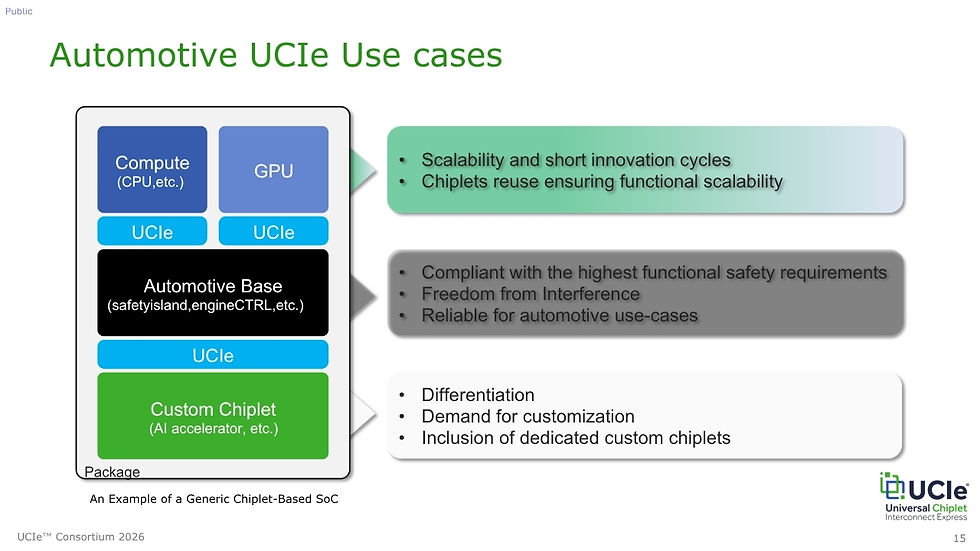
UCIe already includes capabilities relevant to robust die-to-die communication, including error detection, retry mechanisms, link-state monitoring, lane repair, error reporting and management interfaces. UCIe itself does not define ISO 26262 safety requirements or Automotive Safety Integrity Level targets, but its capabilities can provide building blocks that automotive system designers can incorporate into their broader functional safety strategies.

Supporting Automotive Chiplet Innovation
As automotive compute continues to evolve, chiplets have the potential to give system designers greater flexibility to scale, customize and integrate increasingly diverse compute capabilities.
UCIe is pleased to support the automotive sector as it explores that potential. Through an open, standardized and evolving interconnect foundation, and through the ongoing work of the Automotive Working Group, UCIe can help support an ecosystem in which chiplet innovation can develop around the real-world needs of the automotive industry.
Learn more about the UCIe Consortium’s support for automotive chiplet innovation by watching the recent webinar, Driving the Future of Automotive Compute with UCIe, featuring UCIe Automotive Working Group Co-Chairs Bala Chavali of AMD and Dr. Ericles Sousa of Cadence.


